I would like to explain who lives here at FOB Salerno, and some history of one of the Army units. There are many different populations of people here. There are civilian local nationals who work on the base and civilian US personnel who work for KBR, which is a subsidiary of Haliburton. KBR handles many functions such as food service, laundry, plumbing, mechanical, electrical, construction, sanitation, firefighting, computer networking, and many other behind the scenes activities. The company, and all of its employees, are extremely well paid by our tax dollars. There are also CIA personnel and US DOD civilians who work here in various capacities.
There are a variety of Afghani military and police forces who are based here, or frequently visit. You have the Afghan police, the Afghan National Army (ANA), Afghan Border Patrol, Khost Provincial Forces (KPF), and Afghan commandos, who are Afghan special forces.
As far as military personnel, there are a variety of special forces, including Army special forces, Delta force, and I also believe Army Rangers. All three of these forces are independent and they don’t like mingling with each other. The various special forces usually have medics attached, so we get to interact with them occasionally.
There are also quite a few Air Force personnel on base, mostly medical, but also some special forces. These guys go out and find the enemy, then guide Air Force jets in air to ground strikes. There are a few Navy people, and a few Marines.
The vast majority of personnel here however are Army soldiers who belong to the 101st Airborne, headquartered in Fort Campbell, KY. There is an air assault aviation brigade here, utilizing the attack helicopters Kiowa and Apache, and the transport helicopters Blackhawk and Chinook. Most of the soldiers belong to the 4th Brigade Combat Team 506th Infantry Regiment.

The 101st Airborne Division "Screaming Eagles" patch
Following is a brief history of the 506th Infantry Regiment copied from globalsecurity.org.
The mission of the 4th Brigade Combat Team, 101st Airborne Division is to, when directed, rapidly deploy by air, land, or sea to conduct full spectrum operations in support of the Regional Combatant Commander's Requirements.
The 506th Parachute Infantry Regiment was activated on 20 July 1942 at Mount Currahee, Camp Toccoa, Georgia, as part of the newly formed 101st Airborne Division. Currahee was a Cherokee Indian word meaning "Stands Alone," a phrase which later became the Regiment's motto. Led by their Regimental Commander, COL Robert F. Sink, the Regiment conducted a 137-mile forced march from Camp Toccoa to Fort Benning to begin Airborne training. They were the first Parachute Infantry Regiment to complete Airborne training as a unit. The 506th Infantry was the sixth parachute regiment constituted in the US Army.

The 506th Infantry Regiment motto: "CURRAHEE STANDS ALONE"
Their training continued in England until 5 June, 1944 when the 506th suited up for a different kind of parachute jump. At 0100 hours, 6 June 1944, the Regiment jumped into the skies over France as the lead element of the massive Allied D-Day invasion. Their objective was to seize the high ground immediately behind the Normandy beach. By the evening of 6 June 1944, the Regiment had secured its objectives, and had linked up with other elements of the invasion force who had established a beachhead at Normandy. For its exploits at Normandy, the 506th Infantry Regiment received a Presidential Unit Citation, and 25 of its members received the Distinguished Service Cross.
Currahee is also well known for the book and HBO miniseries “Band of Brothers”, the story of Easy Company in the 506th Infantry Regiment during D-Day and battles afterward. So the Army division here definitely has a rich tradition.
These are the guys who go "outside the wire" everyday risking their lives. This is about as close as I can get to the edge of the FOB.

Beyond this fence line you no longer have the protection of the base. Sometimes I feel a little guilty that I am not one of the ones venturing out into the mountains, that I always have the protection of the base and therefore a lot less risk. In fact there is a slang term for people like me who never leave the FOB: "Fobbitt."
As an Air Force person living on base, you just don't feel quite as tough as those Army guys leaving the base in their armored vehicles with top mounted 50 cals.

It's all good though; we understand our role is critical, and our being here and ready 24/7 gives those guys security when bad things happen.
 Colonel M and Capt G (anesthesia CRNA's-the two left) prepare to intubate a person with a severely burned face from combat.
 Trauma sustained to armpit. Femoral vein was grafted to brachial artery to save the arm.
We are also here to take care of emergencies in the local civilian population. I can show this cute baby because her story has already been published in the US media. She is a 9 month old who came in with 3rd degree burns to her legs and feet. We took skin grafts from her thighs and transferred to the burned areas. She recovered well after 3 weeks and went home with her mom.
That's all for this post, I'll try not to wait so long before I post again. Thanks for visiting!


 Like I said: madness.

 Very ceremonial.


 Like I said: madness.


 Nate and I pose for the camera before the action begins.
 This is one of the trucks they drive and was the one I rode in this day. The truck is loaded with toys, both inside and out.
 So, I really did not think that after going through med school, I'd ever have the chance to hold a block of C4 explosive, but here I am! They showed me how to cut a wedge out of the end, embed detonation wire, and tape it up for use.
 The guys are explaining how to tie the ring of detonation wire so that all 6 of our blocks of C4 will explode simultaneously.


 Not to waste any explosive, 3 pounds of C4 is molded into a shape charge and placed in front of this iron plate. The iron plate is about 1 cm thick. This charge is linked to the other 6 blocks, giving us about 12 pounds of C4!
 Rich calls to the command post to inform them of our impending explosion. The people in charge probably wouldn't appreciate any large unannounced blasts. We set the fuse, which ignites the detonation cord. Since the det cord burns at a controlled rate, we have a set number of minutes to drive to our observation point.
 After we blow a hole in the side of the mountain, we return to check the damage.


 Usually on Sunday nights they have one of these get togethers and light up the grill. You can pretty much see all the people who go around the base in civilian clothes and beards---SF, CIA, and FBI.
 The best part is just getting to eat somewhere besides the dining facility once in a while!


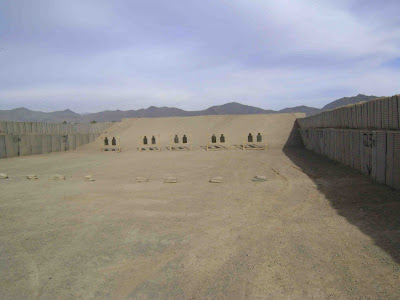
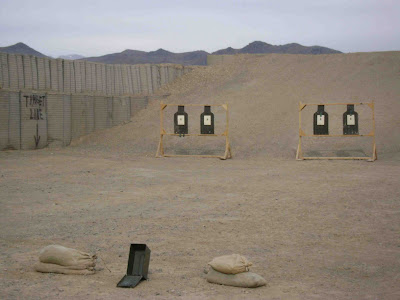
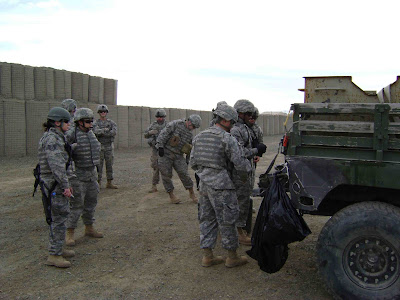
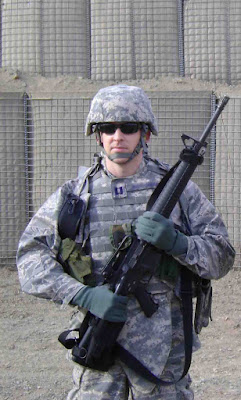

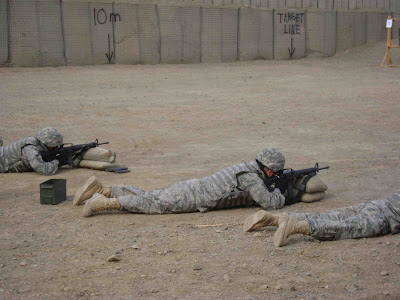 I look through the site, breathe in, breathe out, and squeeze slowly. This minimizes how much you move your weapon and increases accuracy.
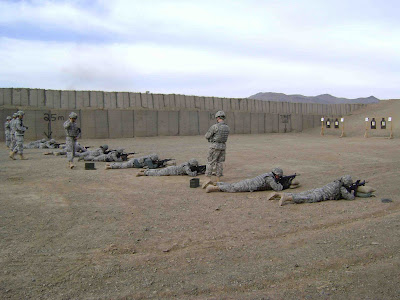 My friend to my right let me know afterward that it was hard for him to concentrate on his target because my M-16 was ejecting shell casings all over him. Ha.
 My target. You can see my first 3 attempts (which were 3 shots each) low and to the right. My next 2 attempts were better, but not perfect. Unfortunately, at this point a trauma alert was heard over the loud speaker, so essential medical personnel had to go back to the hospital. We had to miss the majority of shooting, and getting to shoot the M-16 in burst mode. But they promised me we could come back soon. I will hold them to it!


